What Islam Really Says About Hair: A Clear Guide to Rulings, Etiquettes, and a Halal Healthy Routine
Hair is a blessing from Allah—and caring for it is an act of gratitude.
When we think about Islam, we often think of prayer, charity, fasting, and worship.
But our beautiful religion also cares about the small details of daily life—including how we care for our hair.
For many Muslims today, there is confusion:
- Is dye halal?
- Can women cut their hair?
- Do we have a Sunnah routine?
- Which oils are Islamic?
- Is modern hair care allowed?
Let’s begin with clarity, honesty, and respect for the Deen.
1. What Islam Clearly Says About Hair (Quran & Authentic Sunnah)
Islam states that women should cover their hair with a headscarf as part of modest dress, supported by the Quran and authentic Sunnah. The Quran commands women to draw their headscarves over their chests (24:31) and to draw their outer garments over themselves (33:59). The Sunnah provides specific context, such as the reaction of the early Muslim women when these verses were revealed, where they immediately began covering their hair.
Quranic verses
- Surah An-Nur 24-31: “And tell the believing women to… wrap their headcovers over their chests.” This is interpreted as requiring a headscarf that covers the hair and also the neck and chest area.
- Surah Al-Ahzab 33-59: “O Prophet, tell your wives and your daughters and the women of the believers to bring down over themselves [part] of their outer garments.” This verse is understood as a command for general modesty, which includes covering the head and body.
But Islam gives beautiful principles and rulings about hair.
A. A Famous Authentic Teaching
The Prophet said:
“Whoever has hair should honor it.”
(Sunan Abi Dawud)
This is the foundation of Islamic hair care.
Honoring hair means:
- Keeping it clean
- Keeping it neat
- Treating it with care
- Avoiding harmful practices
B. Hair dye in islam
Dye is permissible (halal) under certain conditions: it should not be black dye used to cover gray hair, it should not involve imitating non-believers, and the dye itself must be pure and not harmful. Any color other than black is generally allowed, as long as it doesn’t violate these rules. If the dye prevents water from reaching the hair, it is not permissible for rituals like Wudu.
Permissible conditions
- Avoid pure black dye: It is prohibited to dye hair pure black to cover gray hair, based on a Hadith from the Prophet Muhammad. However, if the black dye is mixed with other colors and is no longer pure black, it is generally acceptable.
- Do not imitate non-believers: The color and style should not be a practice exclusive to non-believers, as it can be seen as an imitation of them.
- Ensure purity and safety: The dye must be made of pure and permissible materials and not be medically harmful. For instance, henna is considered halal, but it’s important to check that any modern dyes are free from impermissible ingredients.
- Avoid imitating the opposite gender: The color choice should not be an attempt to imitate the opposite gender.
- Allow water to pass through: If the dye is impermeable and blocks water from reaching the hair and skin, it is not permissible for rituals like Wudu and Ghusl.
Examples of impermissible dye
- Pure black dye for gray hair.
- Dyes that are harmful or impure.
- Dyes that imitate non-believers
C. Forbidden Styles in Islam
For men
- Qaza: Shaving some parts of the head and leaving others long is forbidden. This includes styles like a mohawk or shaving the sides while leaving the top longer.
- Imitating disbelievers or immoral people: Styles that resemble those of nonbelievers or those with ill repute are prohibited.
- Imitating women: Styles that intentionally resemble feminine hairstyles, such as a high ponytail, are forbidden if done without a beard.
For women
- Imitating disbelieving or immoral women: Hairstyles that are specifically adopted to copy non-believers or women of ill-repute are not allowed.
- Imitating men: Cutting hair in a way that resembles a masculine hairstyle is prohibited.
- Flaunting hair: Displaying hair in a manner intended for non-mahram men is not permissible.
- Imitation: Some scholars also consider styles that involve artificial materials, like hair extensions, to be haram because they are seen as altering Allah’s creation.
Permitted hairstyles
- Neat and moderate haircuts that do not resemble those of disbelievers.
- Keeping all hair the same length or having a normal haircut without shaved parts.
D. What Islam Allows
- Cutting hair (men & women), if modest
- Using oils
- Using herbal treatments
- Using modern treatments (keratin, straightening, etc.) if there are no haram ingredients
- Dyeing hair any color except pure black for deception
Islam is balanced and practical.
2. Islamic Principles You Can Use to Build Any Halal Routine
Since Islam does not give a detailed step-by-step “hair routine,” your routine should follow these principles:
Cleanliness
Hair should not be dirty, greasy, or smelly.
Avoid Harm
Treatments that burn, damage, or harm your health should be avoided.
Modesty (for women)
Hair is ‘awrah in front of non-mahram men.
No arrogance
Hairstyles should not be done for showing off.
No imitating the opposite gender
Men and women should maintain their natural identity.
Use halal ingredients
Avoid haram animal-based or alcohol-heavy products.
Once you follow these principles, any healthy route is allowed, even if not directly mentioned in Islam.
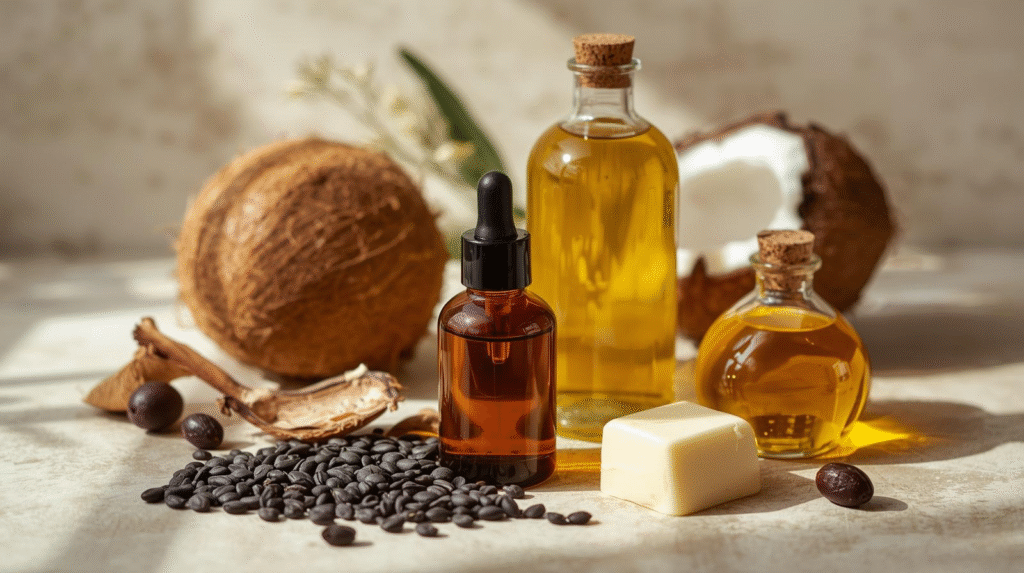
4. Oils That Commonly Used For Hair (Natural, Balanced Advice)
Islam praises oiling but does not name a specific hair oil routine.
So here we give halal, natural, beneficial options that fit Islamic values of cleanliness and self-care.
A. Black Seed Oil (Kalonji)
Mentioned in hadith as healing.
Benefits
- Reduces hair fall
- Strengthens follicles
- Helps with dandruff
- Good for thinning areas
Quality Signs
- Dark golden color
- Strong herbal smell
- Cold-pressed
- 100% pure
How to Use
- Mix with olive or coconut
- Warm slightly
- Leave 30–60 minutes
- Twice a week
B. Olive Oil
Mentioned in the Qur’an as mubarak (blessed).
Benefits
- Deep moisture
- Reduces breakage
- Softens dry hair
- Good shine
How to Use
- Warm lightly
- Apply root to tip
- Leave 1–2 hours
- 2–3 times weekly
C. Coconut Oil
Natural protector.
Benefits
- Prevents protein loss
- Fixes split ends
- Softens frizz
- Strengthens hair
How to Use
- Warm
- Apply more on ends
- Leave 1–3 hours
D. Mustard Oil (Sarson)
Strong but effective.
Benefits
- Boosts blood flow
- Increases growth
- Helps with infections
Use carefully
- Always mix with olive/coconut
- Leave only 20–40 minutes
- Use once a week
E. Castor Oil
Thick, strong oil.
Benefits
- Thickens hair
- Helps bald spots
- Strengthens edges
Use
- Mix with lighter oils
- Leave 40–60 minutes
- Once weekly
5. Small, Practical Solutions for Common Problems
Hair fall
- Use black seed and olive mix
- Avoid hot water
- Comb gently
- Reduce stress
Dandruff
- Warm coconut oil and lemon
- Don’t scratch your scalp
- Rinse shampoo properly
Dry hair
- Olive + coconut mask
- Cold water final rinse
- Use satin pillowcase
Weak hair
- Castor oil mixture weekly
- Add protein foods (Sunnah foods: dates, fish, honey)
These small solutions help readers instantly.
6. Islamic FAQ
Is hair dye halal?
Yes, all colors except pure black for deception.
Can women cut their hair?
Yes, if it remains feminine and not imitative of men.
Is keratin allowed?
Allowed if ingredients are halal.
Can I use perfume in my hair?
At home = yes.
Outside is not allowed for women.
Do women need to undo braids for ghusl?
No—only water must reach roots.
Conclusion: Islamic Hair Care Is a Balance of Purity, Beauty, and Gratitude
Caring for your hair is not vanity —
It is self-respect, cleanliness, and gratitude to Allah.
Islam teaches us:
- Stay clean
- Stay dignified
- Avoid harm
- Use halal products
- And honor the blessings you have
Your hair is one of those blessings.
When you care for it gently and thoughtfully,
you bring peace to your body —
and light to your heart.